


Indian drivers must now handle greater responsibilities than merely observing standard traffic regulations. Along with following road safety rules, vehicle owners must also ensure that their vehicles meet the prescribed emission standards and have a valid Pollution Under Control (PUC) certificate. This is where the concept of PUC challan in India becomes relevant. Many vehicle owners ignore their Pollution Under Control certificate until they are fined but with stricter laws now in place this is something you cannot overlook.
A PUC certificate confirms that your vehicle is not releasing harmful pollutants beyond the allowed limits. You can face a fine and other legal consequences if your certificate has expired or you do not have it. Penalties for violating prescribed air-pollution standards were increased under the Motor Vehicles (Amendment) Act, 2019. The blog will explain PUC challan, PUC challan amount, PUC violation fines, and methods to prevent pollution certificate challan.
What is a PUC Challan in India
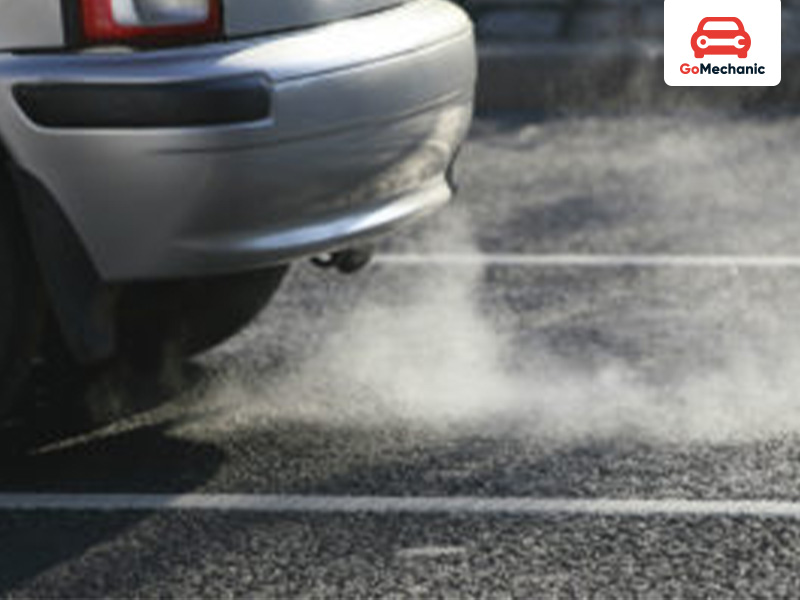
A PUC challan in India is a penalty issued when a vehicle owner drives without a valid Pollution Under Control certificate. Vehicles covered by the applicable emission norms must undergo PUC testing as prescribed under the Central Motor Vehicles Rules.
The certificate is issued after checking the emissions coming from your vehicle’s exhaust. The vehicle meets the applicable pollution-control requirements when its emission levels stay within the prescribed limits. If the vehicle fails the emission test, car repair may be required to fix the underlying issue and bring the vehicle within the required emission standards. Authorities can issue a challan when they catch you driving without a valid PUC certificate.
Why PUC Certificate is Important
The PUC certificate serves as a key instrument that enables authorities to regulate air pollution emissions. India faces severe pollution problems because vehicles represent one of the largest pollution sources in its urban environments. Your vehicle emissions testing compliance demonstrates your dedication to environmental protection. The legal requirement needs to be fulfilled because it provides both environmental protection and legal protection. Operators who drive vehicles without valid PUC certificates face substantial financial penalties and, in cases covered by Section 190(2) of the Motor Vehicles Act, additional legal consequences may apply. The vehicle emission results show how well the vehicle has been serviced because high emissions can indicate problems with the engine, fuel system, exhaust system or emission-control components.
Also read: India Gets Uniform PUC (Pollution Under Control) Norms
PUC Challan Amount and Fine Details
The PUC challan amount has experienced a substantial increase since the Motor Vehicles (Amendment) Act, 2019 came into effect. Under Section 190(2), driving a vehicle that violates prescribed standards relating to road safety, noise or air pollution can attract a fine of up to ₹10,000. For a first offence, imprisonment of up to three months may also apply, and the driver can be disqualified from holding a driving licence for three months. A second or subsequent offence can attract imprisonment of up to six months, a fine of up to ₹10,000, or both.
| Violation Type | Fine Amount | Additional Action |
| No valid PUC certificate | Up to ₹10,000 |
Action may be taken under applicable state enforcement rules and Section 190(2) |
| Expired PUC certificate | Up to ₹10,000 |
Treated as not having a valid PUCC for enforcement purposes |
| Violation of prescribed air-pollution standards | Up to ₹10,000 | For a first offence, imprisonment up to 3 months or both may apply, along with driving-licence disqualification for 3 months |
For example, Delhi Traffic Police lists driving without a valid PUCC as an offence carrying a ₹10,000 penalty under Rule 115 of the Central Motor Vehicles Rules read with Section 190(2) of the Motor Vehicles Act. Enforcement and compounding procedures can vary by state or Union Territory.
Validity of PUC Certificate
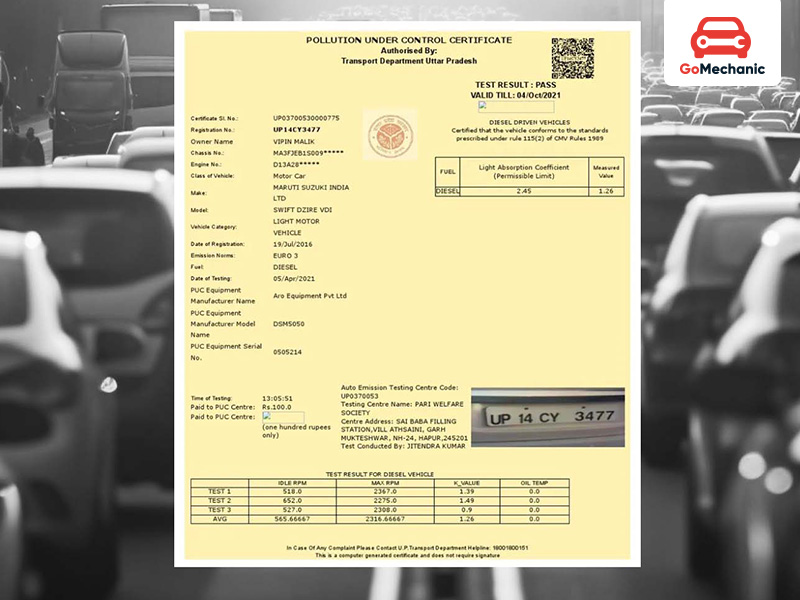
The validity of a PUC certificate depends on the vehicle and applicable rules. New vehicles are generally exempt from PUC testing for the first year from the date of registration. After the first year, vehicles are generally required to undergo emission testing every six months.
The expiry date needs to be monitored continuously. Many people forget to renew it on time and end up paying a pollution certificate challan. The process of renewing your certificate takes only a few minutes and costs little money while protecting you from future fines.
How to Check PUC Status
- You can check your PUC certificate status through the official Parivahan PUC portal using your vehicle registration number and the required chassis-number details.
- The system enables users to verify their PUC certificate status which indicates whether their certificate remains valid or has expired.
- Vehicle owners frequently lose their physical certificate or forget about their expiration date which results in them receiving unnecessary traffic fines during checkpoints.
- The online status check provides information about your vehicle’s emission compliance and helps you schedule certificate renewal.
- The practice of checking your PUC status enables you to avoid expensive challans while ensuring your vehicle meets India’s pollution control standards.
- The process enables users to do their tasks from any location using their mobile devices or laptops without needing to visit a PUC centre. Vehicle owners can also check PUCC validity and other vehicle-document details through mParivahan.
How to Avoid PUC Challan in India
You can prevent getting a PUC challan in India by following these three basic practices. First, your PUC certificate needs to be valid at all times. You can use a renewal reminder system to help you maintain your renewal schedule. Your vehicle requires both regular servicing and maintenance work. An engine that receives proper maintenance produces less pollution and has a better chance of passing emissions tests. The quality of fuel an also affect combustion and vehicle emissions, so use the fuel grade recommended by the vehicle manufacturer and refuel from reliable outlets.
It is recommended that you carry a physical copy of your PUC certificate or keep an accepted digital version available through DigiLocker or mParivahan. Traffic authorities recognise documents presented through these government platforms.
Where to Get a PUC Certificate
PUC certificates are easily available at authorised emission testing centres across India. These centres are located at many petrol pumps, workshops and authorised PUC testing locations. The process needs only several minutes to finish. The machine tests your vehicle emissions, and if all results are satisfactory, the system generates your certificate right away. PUC testing is relatively inexpensive compared with the penalty that may apply for driving without a valid certificate.
Related blog: Your Car AC Can Reduce in-car Air Pollution By 34%. Here’s How!
Conclusion
Every vehicle owner in India needs to know the PUC challan regulations which apply to their vehicles. Responsible driving requires more than just avoiding fines because it involves demonstrating safe driving practices. Your PUC certificate is a legal compliance requirement for vehicles covered by emission-testing rules, and violations can attract a fine of up to ₹10,000 along with other consequences under Section 190(2). The process of maintaining a valid PUC certificate requires minimal effort and expense. You can maintain your compliance status by performing vehicle servicing and renewing your PUC certificate while knowing all applicable regulations. The solution results in financial savings, which also promotes environmental protection through cleaner air and healthier ecosystems.
By taking small steps like checking your PUC status and keeping your vehicle in good condition, you can avoid a pollution certificate challan and drive stress-free on Indian roads.
FAQs
1. Is there any challan on PUC?
Yes. Driving without a valid Pollution Under Control (PUC) certificate can result in a traffic challan. For example, Delhi Traffic Police lists the penalty for driving without a PUCC at ₹10,000 under Rule 115 of the Central Motor Vehicles Rules read with Section 190(2) of the Motor Vehicles Act. Enforcement procedures may vary between states and Union Territories.
2. How much fine if PUC is expired?
An expired PUC certificate means you no longer have a valid PUCC. Under the applicable pollution-control provisions, the penalty can extend up to ₹10,000. Depending on the offence and enforcement procedure, additional legal consequences under Section 190(2) may also apply. Renew the certificate before its expiry date to avoid a PUC challan.
3. What is the fine for no PUC in India?
In India, the fine for driving without a PUC certificate can be up to ₹10,000. Section 190(2) also provides for imprisonment of up to three months for a first offence, or both imprisonment and fine, along with disqualification from holding a driving licence for three months. For subsequent offences, imprisonment can extend to six months, or a fine of up to ₹10,000, or both.
4. How much fine is there for PUC?
The penalty can go up to ₹10,000 for violations covered by Section 190(2) of the Motor Vehicles Act. The exact enforcement and compounding process may differ by state or Union Territory, so vehicle owners should check the rules applicable where their vehicle is being driven. Keeping the PUC certificate valid is the simplest way to avoid the penalty.
5. Can traffic police ask for PUC in India?
In India, traffic police possess the authority to request your PUC certificate during their vehicle inspection process. Drivers must present PUC as one of their essential vehicle documents together with RC, insurance and driving licence.The documents can be shown physically or through recognised digital platforms such as DigiLocker or mParivahan.